
Learn how to automate PSP reconciliation workflows in iGaming, control exceptions, speed close, and keep revenue, cash, fees, and duty auditable daily.
← All insights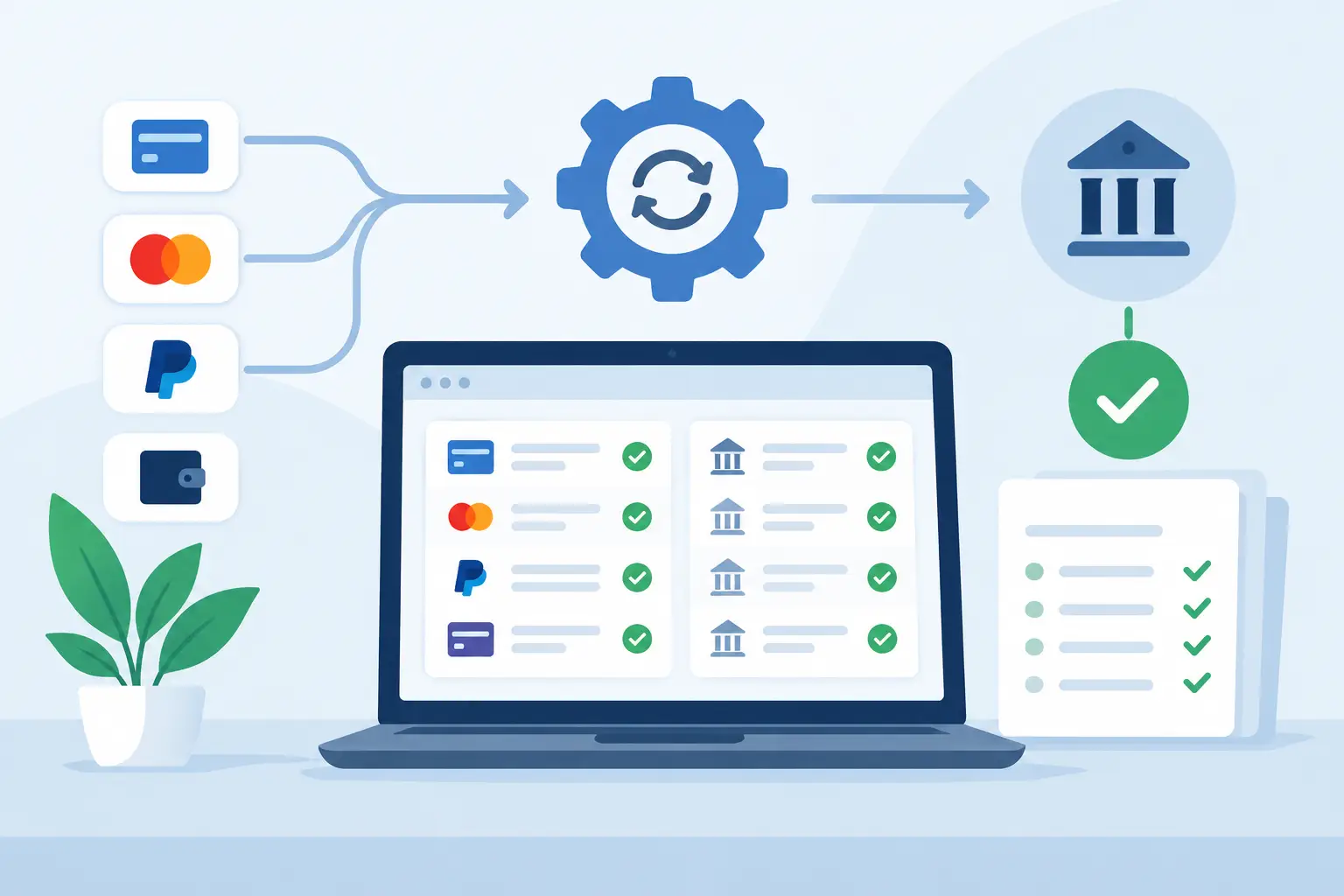
A PSP balance that agrees to the bank but cannot be explained by player transactions is not reconciled. It is merely balanced. To automate PSP reconciliation workflows in iGaming, finance teams need to match the full path of money: the player event, the PSP event, the settlement movement, the bank receipt or payment, and the accounting entry. Anything less leaves timing differences, fees, reserves, chargebacks, and FX movements for month-end spreadsheets.
That distinction matters because PSP reconciliation is not an administrative back-office task. It is a control over cash, revenue deductions, player liabilities, payment costs, and often the accuracy of gaming-duty reporting. For a multi-market operator, weak reconciliation also obscures a more commercial question: which deposit and withdrawal routes are actually profitable after fees, declines, chargebacks, and local payment-method economics?
Most operators begin with a workable process: export a PSP report, compare it with a payment-platform file, trace material differences, and post a journal. It works until transaction volumes, jurisdictions, PSPs, currencies, and product lines expand. Then a process designed for a few thousand records begins handling millions of rows and several definitions of “paid.”
A player deposit may be authorized on one day, captured on another, settled by the PSP later, and received in the bank net of fees and a rolling reserve. A withdrawal may be approved in the wallet before the PSP releases cash. A chargeback can reverse an earlier deposit after revenue has moved through the gaming ledger. If finance matches only daily totals, those events are compressed into a number that may look plausible while masking aged exceptions and misclassified cash.
Generic ERP configuration often makes this worse. It treats each provider file as a bank-like statement and posts broad clearing-account journals. But PSP data is transaction-level operational evidence, not simply cash movement. iGaming needs an accounting design that respects the difference between player funds, GGR, NGR deductions, settlement cash, PSP fees, and revenue recognized under the applicable policy.
Automation is not importing files faster. It is a controlled matching process with defined accounting outcomes for every transaction state. The system should ingest source data on a scheduled basis, normalize it to a common structure, match records using durable identifiers and rules, route exceptions to named owners, and create or validate accounting entries without relying on uncontrolled journals.
The payment or wallet ledger should establish the underlying player event: deposit, withdrawal, refund, chargeback, reversal, bonus-related adjustment, or fee. Each record needs a stable transaction identifier, player or wallet reference where appropriate, currency, gross amount, event timestamp, status, PSP, payment method, and legal entity or market.
The PSP feed then confirms how that event progressed through the provider. The bank statement confirms the cash movement. These sources should not be forced into the same date. A transaction can be economically valid on one date and settle in cash on another. The reconciliation logic must preserve both dates and post the difference to a clearly defined PSP clearing account.
This is where the right chart of accounts matters. One undifferentiated “payment provider clearing” account may be tolerable for a single PSP. It becomes a poor control model when an operator has multiple providers, currencies, entities, and settlement arrangements. Clearing positions should be visible by the dimension finance needs to manage - commonly PSP, legal entity, currency, and settlement account.
An exact match on the operator transaction ID and PSP reference is the cleanest outcome. It should be the default, not the only method. Providers may split settlements, batch transactions, apply payout netting, or issue separate fee and reserve lines. In those cases, matching rules may need to group transactions by settlement ID, currency, amount, direction, and tolerable timing window.
The rule is simple: use automation to resolve known patterns, not to hide uncertainty. A match created by amount and date alone may be acceptable for a clearly understood settlement batch. It should not silently reconcile unrelated transactions that happen to share a value. Every non-exact match needs a rule that finance can explain to an auditor and revisit when a PSP changes its reporting format.
Settlement is often net, but accounting and commercial analysis cannot be. If a PSP remits $96,500 against $100,000 of deposits, the missing $3,500 may include processing fees, rolling-reserve movements, FX conversion, refunds, or prior-period adjustments. Posting the net receipt against deposits conceals the payment cost and can leave player-liability balances wrong.
A sound workflow identifies each component and posts it to its proper destination. Gross player transactions clear the relevant wallet or player-funds liability. Processing fees move to payment costs. Reserve movements are tracked as restricted or receivable cash, according to the arrangement. Foreign-exchange differences follow the operator's accounting policy. Refunds and chargebacks are linked back to the originating event rather than treated as unexplained negative settlements.
That granularity also changes commercial decision-making. Finance can see whether a payment method is expensive because of headline fees, refund behavior, dispute rates, reserve requirements, or settlement delays. Commercial teams can then make route and pricing decisions from real economics, not blended monthly estimates.
The value of reconciliation automation is not that every line matches. The value is that the unmatched lines become small, classified, owned, and visible before month-end. An exception queue should distinguish between expected timing items and genuine breaks.
Useful categories include pending settlement, missing PSP record, missing internal record, amount mismatch, duplicate transaction, fee variance, reserve movement, chargeback mismatch, currency variance, and bank settlement not allocated. Each category should have an owner, a required action, and an aging threshold. A withdrawal pending for 24 hours is ordinary. A deposit missing from PSP records for five days may indicate an integration, operational, or customer-funds issue.
Finance leadership should be able to see the opening balance, period movement, matched value, unmatched value, aged exceptions, and closing balance for every PSP clearing account. The same view should drill to transaction evidence. A close pack that contains only a signed-off total does not provide sufficient control when the underlying population is high-volume and fast-moving.
The best starting point is not a list of integrations. It is a reconciliation specification agreed by finance, payments, operations, and accounting policy owners. Define the source of truth for each event, the expected timing from authorization to settlement, the required matching keys, treatment of fees and reserves, tolerances, approval rules, and evidence retained for audit.
Then implement in a deliberate sequence. First, establish the data model and transaction identifiers. Second, automate the highest-volume, most standardized PSPs and payment methods. Third, configure exception workflows and clearing-account reporting. Finally, extend the model to lower-volume providers, complex settlement arrangements, and historical clean-up. Trying to automate every provider on day one usually reproduces existing inconsistencies at greater speed.
For operators using NetSuite, the objective is to make this logic native to the financial system: reconciliations linked to source transactions, controlled posting, entity and currency dimensions, and reporting that reconciles operational data to the general ledger. Artio's approach is boutique by design because this work cannot be reduced to a generic bank-feed setup. The correct configuration depends on the operator's revenue waterfall, player-wallet model, PSP contracts, and jurisdictional reporting obligations.
Not every difference should be auto-posted. Material fee changes, unusual chargeback patterns, manual PSP adjustments, unexplained bank transfers, and changes to reserve terms require review. The right threshold depends on transaction volume, risk appetite, and the significance of the PSP to the business.
Automation should also preserve the original source data and matching history. If a record is rematched after a correction, finance needs to see what changed, who approved it, and which accounting period was affected. That history is as valuable during due diligence or an audit as it is during month-end close.
A well-designed PSP reconciliation workflow gives finance something more useful than fewer spreadsheets: a daily view of cash that ties back to player activity, a controlled explanation for every settlement difference, and payment-cost data the business can act on before the month is over.
The blog is the long read. For your actual numbers — the engine, gaming duty, the close — book a short call with a partner who would configure it.
Independent, objective advice. We reply within one business day.
Prefer to talk? Email [email protected] · call us ›